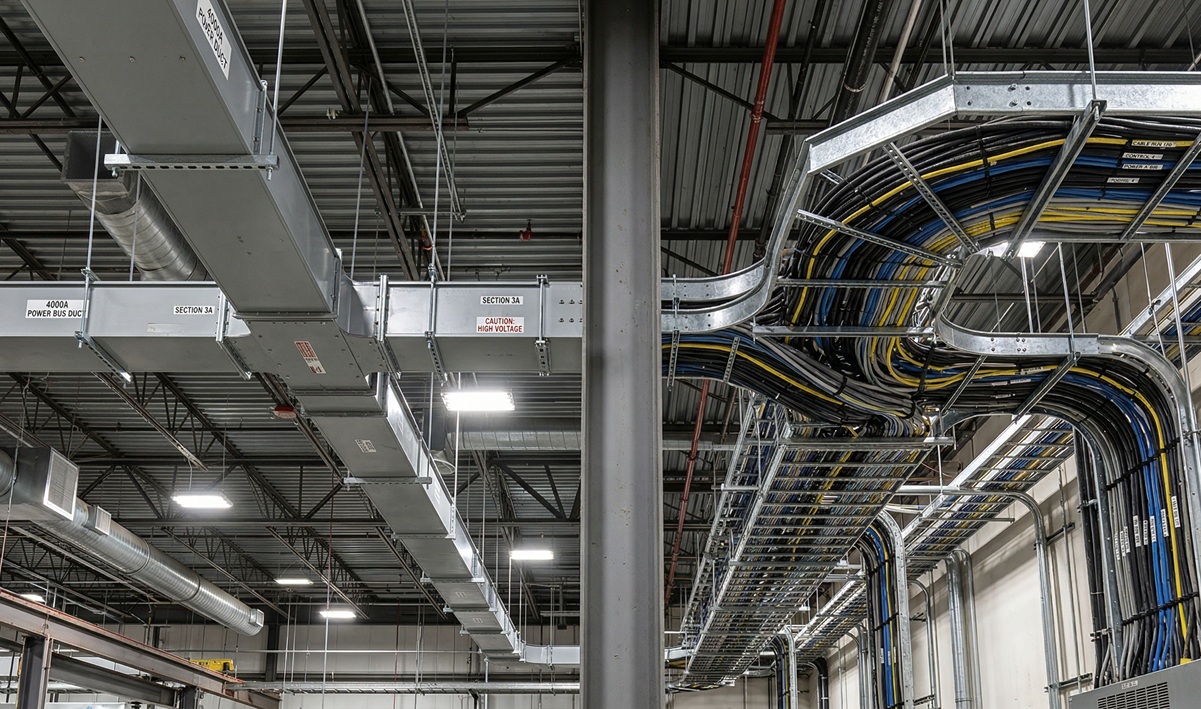
Cabling, cable trays, and bus ducts provide safe, organized, and reliable electrical power distribution across commercial and industrial facilities.
Cabling, cable trays, and bus ducts are essential components of electrical infrastructure designed to transmit and distribute power safely and efficiently. Electrical cables carry power and control signals, while cable trays provide organized support and routing for cables throughout buildings and industrial facilities.
Bus ducts, also known as busway systems, distribute high electrical currents through enclosed copper or aluminum busbars. They offer a compact and flexible alternative to conventional cabling for applications requiring reliable power distribution across multiple locations.
These solutions are widely used in commercial buildings, factories, hospitals, data centers, shopping malls, and infrastructure projects. Proper sizing, installation, support, and protection help ensure electrical safety, efficient power transmission, and long-term system reliability.
Reliable power transmission
Organized cable routing
Durable support structures
High-current busbar distribution
Flexible installation configurations
Copper and aluminum conductors
Enhanced electrical safety
Space-efficient distribution systems
Easy maintenance access
Scalable power infrastructure
| Parameter | Specification |
|---|---|
| Product Type | Cables / Trays / Bus Ducts |
| Cable Type | Power / Control / Instrumentation |
| Conductor Material | Copper / Aluminum |
| Insulation Type | XLPE / PVC |
| Rated Voltage | Application Dependent |
| Cable Tray Type | Ladder / Perforated / Solid |
| Tray Material | GI / Aluminum / Stainless Steel |
| Bus Duct Type | Sandwich / Air-Insulated |
| Busbar Material | Copper / Aluminum |
| Current Rating | Model Dependent |
| Protection Rating | IP Rating Dependent |
| Installation Type | Indoor / Outdoor |
| Applicable Standards | Relevant IEC / IS Standards |
| Application | Commercial and Industrial Electrical Systems |
*Values vary by project and selected model — final specification is confirmed at the time of quotation based on site requirements.
Share your flow, head, and site details — we'll recommend the right model and configuration.
Request a Quote

Description goes here...